|
|
Code Number: 6A40.40
Demo Title: Refraction - Variable Index of Refraction - Mirage
Condition: Excellent
Principle: Variable Index of Refraction
Area of Study: Optics
Equipment:
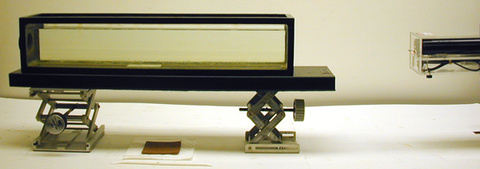
Optics tank, laser, jack stands, cork pad, stirring rods, front surface mirror, and white syrup (KARO) or sugar water.
Procedure:
You can make this demo up the day before.
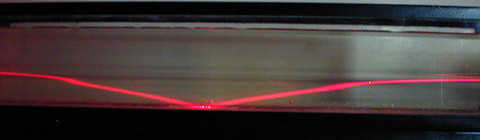
PREFFERED METHOD as the sugar solution mentioned below usually has non-dissolvable particles in it thereby giving a more cloudy solution. Pour two-quart bottles of white syrup into the bottom of the tank. Use more white syrup to make 1500 ml solutions that are 75%, 50%, 25%, and 10% saturated. Float the cork pad on the 2 liters of saturated solution in the tank and then pour in the 75% saturated solution over the cork pad then repeat this procedure with the other three solution. (The cork pad keeps the mixing of the interfaces between the solutions to a minimum so that you get a very good variable index of refraction solution when you are done). Shine a laser into the flat end of the tank and you should see the laser beam bend toward the bottom of the tank. For an added effect you may place a front surface mirror at the point where the laser beam hits the bottom of the tank. This will give you another curved beam reflected outward. The solution gradient is very stable and if you move the table around carefully to avoid any undue mixing will remain for several days.
Mix up 5 liters of saturated sugar water. Pour 2 liters of that solution into the bottom of the tank. With the remainder of the stock make 1500 ml solutions that are 75%, 50%, 25%, and 10% saturated. Float the cork pad on the 2 liter saturated solution in the tank and pour the 75% saturated solution over the cork pad then repeat this procedure with the other three solutions. Shine a laser into the flat end of the tank and you should see the laser beam bend toward the bottom of the tank. For an added effect you may place a front surface mirror at the point where the laser beam hits the bottom of the tank. This will give you another curved beam reflected outward. Be aware that regular sugar usually has some particles that will not dissolve and will give a cloudy solution that will disperse the laser beam. Letting the solution sit for a day so the particles precipitate out will help greatly.
A variation on this demo is to carefully pour Ethyl Alcohol on top of a layer of water. In this case the beam will curve upward instead of downward.
References:
- John A. Bloom, "Eye-Opening Mirages", TPT, Vol. 60, #2, Feb. 2022, p. 84.
- Gregory A. DiLisi, "The Sinking of the R.M.S. Titanic: A Case Study in Thermal Inversion and Atmospheric Refraction Phenomena", TPT, Vol. 60, #1, Jan. 2022, p. 11.
- Front Cover Photo, TPT, Vol. 60, #1, Jan. 2022. p. 1.
- Yuan Zheng, Zewei Huang, Yanbin Yang, "A Simple Way to Demonstrate and Explain Different Facets of Mirage", TPT, Vol. 59, #6, Sept. 2021, p. 422.
- Mario Branca, "Simulation of the Inferior Mirage", TPT, Vol. 48, # 9, December. 2010, p. 565.
- Mario Branca, "Simulation of the Inferior Mirage", TPT, Vol. 48, # 6, Sept. 2010, p. 372.
- Richard M. Heavers, "Oscillations in a Linearly Stratified Salt Solution", TPT, Vol. 45, # 4, April 2007, p. 241.
- Paul Gluck, "Material and Optical Densities", TPT, Vol. 45, # 3, March 2007, p. 140.
- Lauren Richey, Bailey Stewart, Justin Peatross, "Creating and Analyzing a Mirage", TPT, Vol. 44, # 7, Oct. 2006, p. 460.
- Carl H. Tape, "Aquarium, Computer, and Alaska Range Mirages", TPT, Vol. 38, # 5, May 2000, p. 308.
- Se-yuen Mak, "Showing the Light Path of a Mirage", TPT, Vol. 31, # 8, Nov. 1993, p. 476.
- Jinsong Cui, "A Demonstration of the Apparent Ellipticity of the Rising or Setting Sun", TPT, Vol. 29, # 9, p. 566, Dec. 1991.
- J. Wallingford, "More on Mirage Formation", TPT, Vol. 29, # 8, Nov. 1991, p. 485.
- J.F. Davis and T.B. Greenslade, Jr., "Computer Modeling of Mirage Formation", TPT, Vol. 29, # 1, Jan. 1991, p. 47.
- William P. Crummett, "Hard Rock Optics", TPT, Vol. 24, # 7, p. 414, October 1986.
- John B. Johnston, "Atmospheric Refraction", TPT, Vol. 42, March 2004, p. 184. Reprinted from TPT, Vol. 15, # 5, May 1977, p. 308.
- John B. Johnston, "Atmospheric Refraction", TPT, Vol. 15, # 5, May 1977, p. 308.
- Anna Horvath, Balazs Bamer, Gergely Gabor Barnafoldi, "Numerical Simulation of Mirages Above Water Bodies", AJP, Vol. 91, #12, Dec. 2023, p. 999.
- E. Ray, P. Bunton, J. A. Pojman, "Determination of the Diffusion Coefficient Between Corn Syrup and Distilled Water Using a Digital Camera", AJP, Vol. 75, # 10, p. 903, Oct. 2007.
- C. Gaffney, Cheuk-Kin Chau, "Using Refractive Index Gradients to Measure Diffusivity Between Liquids", AJP, Vol. 69, # 7, p. 821, July 2001.
- Waldemar H. Lehn, "Exact Temperature Profile for the Hillingar Mirage", AJP, Vol. 69, # 5, May 2001, p. 598.
- T. Kosa, P. Palffy-Muhoray, "Mirage Mirror on the Wall", AJP, Vol. 68, # 12, December 2000, p. 1120.
- P. R. Barker et al, "A Superior "Superior" Mirage", AJP, p. 953, Vol. 57, No. 10, October 1989.
- Kevin M. Jones, Scott Lundgren, and Alak Chakravorty, "A Calculus of Variations Demonstration: The Gradient Index Lens", AJP, Vol. 56, #12, Dec. 1988, p. 1099.
- George Spagna, "Laser Beam Deflection by Thermal Gradient", AJP, Vol. 51, #5, May 1983, p. 475.
- K. Tennakone, "A Mirage From a Laser", AJP, Vol. 51, #3, Mar. 1983, p. 270.
- E. Fabri, G. Floria, F. Lazzeri, P. Violino, "Mirage in the Laboratory", AJP, Vol. 50, # 6, June 1982, p. 517.
- M.M. Michaelis, "Laser Beam Guidance by Flames", AJP, Vol. 48, # 11, November 1980, p. 990.
- G. P. Sastry, "Teaching Mirages", AJP, Vol. 46, #7, July 1978, p. 765.
- P. L. Dyson, "Comment on Explaining the Mirage", AJP, Vol. 45, #9, Sept. 1977, p. 879.
- E. Khular, K. Thyagarajan, and A. K. Ghatak, "A Note on Mirage Formation", AJP, Vol. 45, #1, Jan. 1977, p. 90.
- A. J. Barnard, B. Ahlborn, "Measurement of Refractive Index Gradient By Deflection of A Laser Beam", AJP, Vol. 43, # 7, July 1975, p. 573.
- Robert T. Bush, Robert S. Robinson, "A Note on Explaining the Mirage", AJP, Vol. 42, # 9, September 1974, p. 774.
- William M. Strouse, "Bouncing Light Beam", AJP, Vol. 40, # 6, June 1972, p. 913.
- Giuseppe Poggi and Carlo Pontiggia, "The Mirage in The Lab", AJP, Vol. 37, #3, Mar. 1969, p. 332.
- Robert Ehrlich, "10.8: Mirage Formation", Why Toast Lands Jelly-Side Down, p.164.
- T. Kallard, "Curving and Bouncing Laser Beam", Exploring Laser Light, p. 58.
- Pat Murphy, Ellen Macaulay, and the staff of the Exploratorium, "Disappearing Puddles", Exploratopia, p. 289.
- Carl. H. Tape, "Aquarium, Computer, and Alaska Range Mirages", TPT, Vol. 38, # 5, May 2000, p. 308.
- M. Minnaert, "IV, The Curvature of Light Rays in the Atmosphere", Nature of Light and Colour in the Open Air, p. 39.
- Jearl Walker, "Bouncing a Light Beam", The Flying Circus of Physics with Answers, p. 119.
- C. Harvey Palmer, "A Note on the Properties of Inhomogeneous Media", Optics - Experiments and Demonstrations, John Hopkins Press, 1962.
- Tik L. Liem, "The Reflecting Brick Wall", Invitations to Science Inquiry - Supplement to 1st and 2nd Ed. p. 93.
- Julius Sumner Miller, Q14 & A14, Millergrams I – Some Enchanting Questions for Enquiring Minds, p. 21 & 80.