|
|
Code Number: 7A60.50
Demo Title: Mu Wave Demo - Bragg Diffraction Planes
Condition: Good
Principle: Bragg Diffraction Planes in Crystal
Area of Study: Optics, Mechanics
Equipment:
Mu wave demo - crystal, Hickok 270 function generator, Amplifier, Microwave power supply, Speaker, X-ray tube (broken).
Procedure:
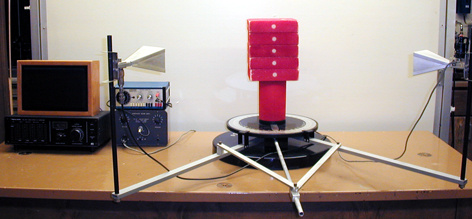
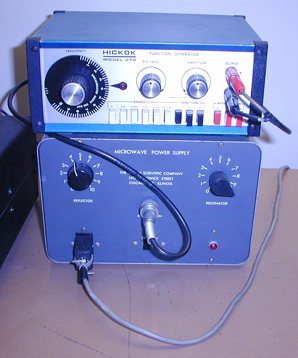
Assemble the demonstration as shown. The wave generator is plugged into the microwave power supply (This is already together as one unit. DO NOT disassemble or play with the setting controls. These are pre-set for instant use.) (Instructions if you screw something up: The Hickok 270 wave generator seems to work best with this setup. The wave generator must be set with the Sine Wave at 0 - attenuation and from between 100 and 800 Hz (this is now hardwired). If the variable control on the microwave power supply is moved, you will have to mess with it to find the place where it will transmit. Be aware this will take a while. The slightest movements of the Resonator and Reflector knobs on the microwave power supply will cause this unit to either work or not work so allow plenty of time for advanced preparation to check things out before taking into the classroom.) Plug the microwave tube/transmitter cable into the microwave supply. Plug the microwave receiver cable into the amplifier and speaker. Do Not turn the microwave power supply on until you are ready to use it. After you turn the supply on, it will take 30 to 45 seconds for the microwave transmitting tube to warm up before you will hear the signal. You should be able to clearly hear this signal by adjusting the angle to one set of the black marks on the Bragg platform if the crystal angle is set at 0 degrees. The Styrofoam/Crystal patterns may be shown and diffraction angles can be measured.
References:
- Tom Ekkens, "Low-Cost Methods for Improving Data Collection Speed in Microwave Bragg Diffraction", TPT, Vol. 60, #8, Nov. 2022, p. 686
- George R. Mitchell, "Correction Please", TPT, Vol. 22, # 3, Mar. 1984, p. 138.
- Earl Zwicker, "The Column Editor Replies", TPT, Vol. 22, # 3, Mar. 1984, p. 138.
- Thomas A. Mitchell, "Braggs Law In A Ripple Tank", TPT, Vol. 16, # 4, Apr. 1978, p. 243.
- Sir Lawrence Bragg, "The History of X-Ray Analysis", TPT, Vol. 3, # 7, Oct. 1965, p. 295.
- Joseph C. Amato, Roger E. Williams, "Rotating Crystal Microwave Bragg Diffraction Apparatus", AJP, Vol. 77, # 10, p. 942, Oct. 2009.
- M. T. Cornick, S. B. Field, "Microwave Bragg Diffraction in a Model Crystal Lattice for the Undergraduate Laboratory", AJP, Vol. 72, # 2, Feb. 2004, p. 154.
- Benjamin S. Perkalskis and J. Reuben Freeman, "Demonstrating Crystal Optics Using Microwaves on Wood Targets", AJP, Vol. 63, #8, Aug. 1995, p. 762.
- Thomas D. Rossing, Rodney Stadum, Douglas Lang, "Bragg Diffraction of Microwaves", AJP, Vol. 41, #1, Jan. 1973, p. 129.
- S. I. Salem et al. "Determination of Avogadro's Number (An Experiment.)", Am. J. Phys. 466, Vol. 56, No. 5, May 1988.
- A. Olah and J. W. Doane, "Experiment in the Bragg Reflection of Light for the Undergraduate Using Cholesteric Liquid Crystals", AJP, Vol. 45, #5, May 1977, p. 485.
- George Bradley and Jacob Dewitt, "Models for Microwave Analogs of Bragg Scattering", AJP, Vol. 36, #10, Oct. 1968, p. 920.
- John J. Connelly, Jr., "Simply Constructed Atomic Stacking Models for Microwave Diffraction Experiments", AJP, Vol. 36, #6, June 1968, p. 559.
- R. Hine, "Elementary Derivation of the Bragg Equation", AJP, 33, # 11, Nov. 1965, p. 962.
- Roland A. Allen, "Verification of Bragg;s Law by the Use of Microwaves", AJP, Vol. 23, # 5, May 1955, p. 297.
- T. G. Bullen, "An Improved Mounting for the Welch-Bragg Diffraction Apparatus", Apparatus Notes, July 1965-December 1972, p. 90.
- George Bradley, Jacob Dewitt, "Models of Microwave Analogs of Bragg Scattering", Apparatus Notes, July 1965-December 1972, p. 77.
- John J. Connelly, Jr., "Simply Constructed Atomic Stacking Models for Microwave Diffraction Experiments", Apparatus Notes, July 1965-December 1972, p. 66.
- Harry F. Meiners, "Microwave Bragg Diffraction Apparatus", The Welch Scientific Company.
- W. Kockelmann, A. Kirfel, S. Siano and C. D. Frost, "Illuminating the Past: The Neutron as a Tool in Archaeology", Physics Education, Vol. 39, (2), 2004, p.155.
- W. Bolton, "The Three-Dimensional Diffraction of Microwaves", Book 2 - Waves and Particles, Physics Experiments and Projects, 1968, p. 37-38.
- W. Bolton, "Refraction of Waves by "Atoms"", Book 2 - Waves and Particles, Physics Experiments and Projects, 1968, p. 39-40.