|
|
Code Number: 5C30.70
Demo Title: The Effect of AC and DC on an RC Circuit
Condition: Good
Principle: Functions of a Capacitor
Area of Study: Electricity and Magnetism
Equipment:
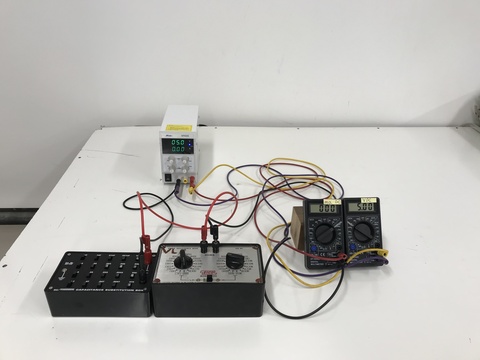
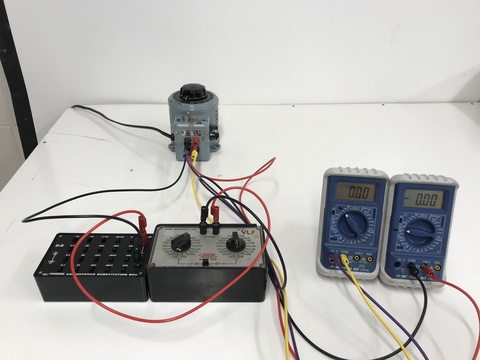
DC Power Supply, Variac, Resistor Box Capacitor Box, Keithley Multimeters (2).
Procedure:
NOTE: This will be easier to set up as two separate circuits as the meter changes over the years make it difficult to go from AC to DC input settings easily.
Put the DC power supply in series with the resistor box and capacitance box, and one of the multimeters to measure current. Set the capacitor to 11.2 Uf and the resistor box to 100,000 ohms (100 K ohms) and the power supply to 5 Volts. Turn the meters on to the marked setting on the face. Turn on the power supply while watching the current measuring meter. With DC voltage the current will rise and then slowly fall back to zero. (Be aware that some meters do not go completely to zero when set at the correct range). Note also that when you turn off the power supply the capacitor will discharge and the current will also rise and then slowly fall to zero until the capacitor is fully discharged.
The AC circuit uses a variac as the power source. The capacitor should be set at 1 Uf and the resistor box set to 1000 ohms. Turn the meters on to the marked setting on the face. Turn on the variac and note that some voltage and current is flowing even when the unit is turned to the lowest setting. Now turn up the voltage and observe the current meter. This time the current will stay constant at any particular voltage you stop at. This is due to the fact that the capacitor is constantly being charged and discharged by the 60 cycle alternating line voltage. Do not go over 20 Volts with this demo.
References: