|
|
|
|
|
|
|
|
|
|
|
|
|
|
Code Number: 3A95.50
Demo Title: Chaos Pendula - Chaos Toys
Condition: Excellent
Principle: Potential to Kinetic Energy, Simple Harmonic Motion
Area of Study: Acoustics
Equipment:
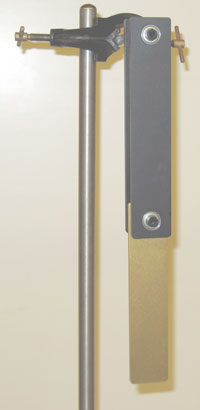
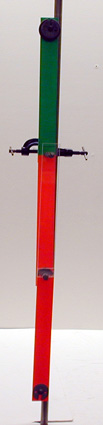
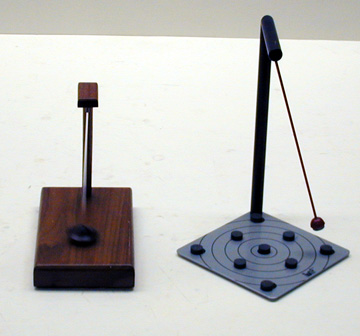
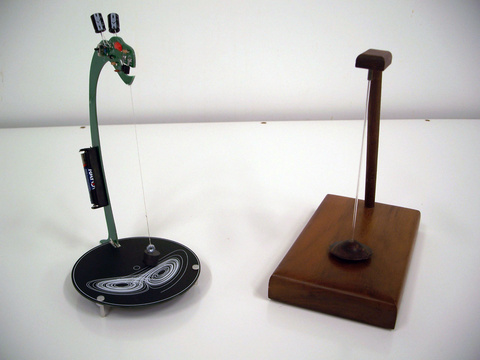
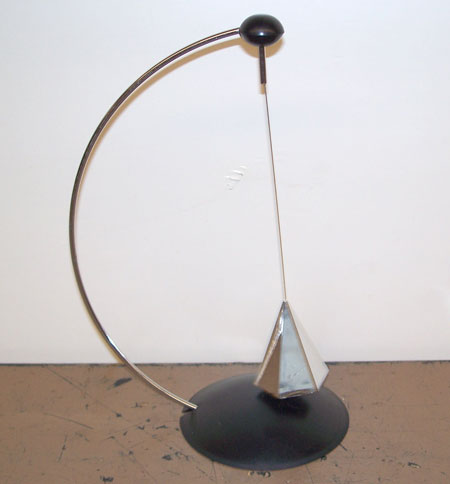
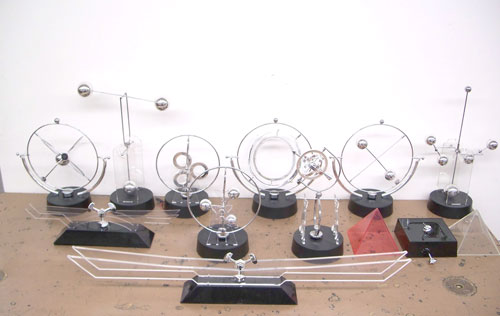
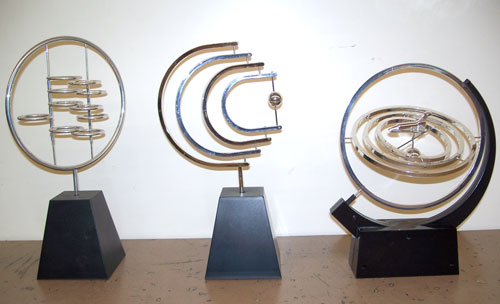
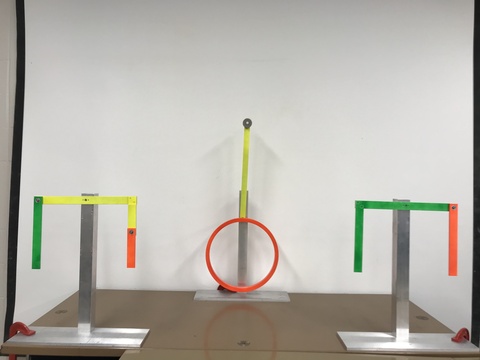
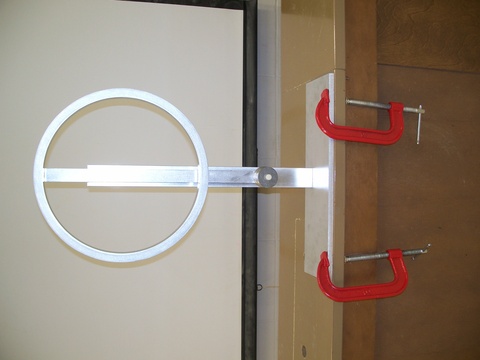
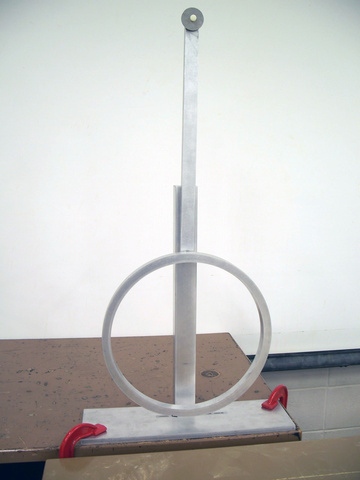
Chaos Pendulums, Double Planar Pendulum, Toy Pendulum Models, and Alogo Pendulum (Ring Pendulum).
Procedure:
See also 3A95.50 in Oscillations/Acoustics.
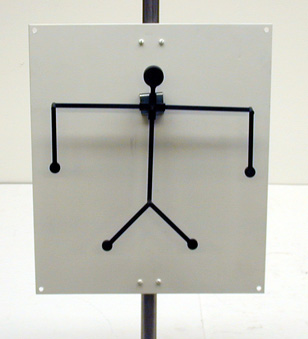
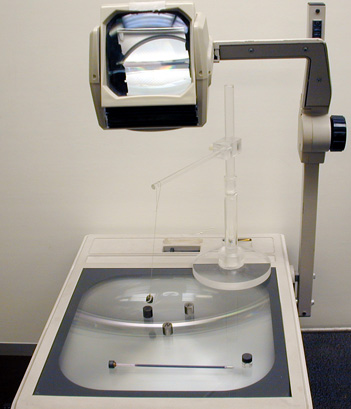
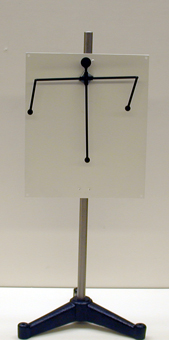
The double planar pendulum shows what the addition of another degree of freedom does to the behavior of a pendulum. The chaos Pendula are designed so that you may go from one degree of freedom to 5 degrees of freedom in many different configurations, usually used for a deeper understanding of chaotic behavior.
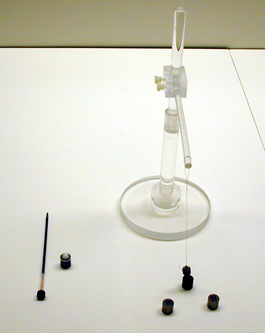
The Alogo pendulum may be started with either the ring in the upward or the downward position by adding the proper counter weight.
The Rott's and modified Rott's pendula are very good demonstrations of chaos and transfer of energy between different parts of the pendulum.
References:
- William A. (Toby) Dittrich, "Drop Tower Physics", TPT, Vol. 52, #9, Sept. 2014, p. 415.
- Fabio Augusto Meira Cassaro, Sergio da Costa Saab, Luiz Antonio Bastos Bernardes, and Jeremias Borges da Silva, "The 'Sparking Chaotic Pendulum': Trajectories of a Chaotic Pendulum Revealed", TPT, Vol. 42, #1, Jan. 2004, p. 47.
- Douglas Oliver, "A Chaotic Pendulum", TPT, Vol. 37, #3, Mar. 1999, p. 174.
- R. W. Robinett and P. E. Sokol, "Investigating Physical Pendula with K’NEXTM", TPT, Vol. 34, #7, Oct. 1996, p. 427.
- Donald H. Esbenshade Jr., "Computer-Specific Initial Conductions and Chaos", TPT, Vol. 32, #1, Jan. 1994, p. 40.
- Alan Cromer and Michael B. Silevitch, "Chaos in the Corridor", TPT, Vol. 30, #6, Sept. 1992, p. 382.
- Marvin L. De Jong, "Chaos and the Simple Pendulum", TPT, Vol. 30, #2, Feb. 1992, p. 115.
- Robert Ehrlich, "Three Mechanical Demonstrations of Chaos", TPT, Vol. 28, #1, Jan. 1990, p. 26.
- Joe Pizzo, "The Perplexing Pendulum", TPT, Vol. 24, #6, Sept. 1986, p. 360.
- Donna A. Berry, "A 'Perpetual Motion' Toy?", TPT, Vol. 20, #5, May 1982, p. 319.
- R. D. Edge, "Coupled and Forced Oscillations", TPT, Vol. 19, #7, Oct. 1981, p. 485.
- R. Mathevet, P. Marchou, C.M. Fabre, N. Lamrani, N. Combe, "Coriolis Acceleration and Critical Slowing-Down: A Quantitative Laboratory Experiment", AJP, Vol. 92, #2, Feb. 2024, p. 100.
- T. Splith, A. Kaps, F. Stallmach, "Phase Plot of a Gravity Pendulum Acquired Via the MEMS Gyroscope and Magnetic Field Sensors of a Smartphone", AJP, Vol. 90, #4, April 2022, p. 314.
- M. Z. Rafat, M. S. Wheatland, and T. R. Bedding, "Dynamics of Double Pendulum With Distributed Mass", AJP, Vol. 77, #3, Mar. 2009, p. 216.
- Robert DeSerio, "Synchronous Analog I/O For acquisition of Chaotic Data in Periodically Driven Systems", AJP, Vol. 72, #4, Apr. 2004, p. 553.
- Priscilla W. Laws, "A Unit on Oscillations, Determinism and Chaos for Introductory Physics Students", AJP, Vol. 72, #4, Apr. 2004, p. 446.
- Robert C. Hilborn, "Sea Gulls, Butterflies, and Grasshoppers: A Brief History of the Butterfly Effect in Nonlinear Dynamics", AJP, Vol. 72, #4, Apr. 2004, p. 425.
- Robert DeSerio, "Chaotic Pendulum: The Complete Attractor", AJP, Vol. 71, #3, Mar. 2003, p. 250.
- John P. Berdahl and Karel Vander Lugt, "Magnetically Driven Chaotic Pendulum, AJP, Vol. 69, #9, Sept. 2001, p. 1016.
- Azad Siahmakoun, Valentina A. French, and Jeffrey Patterson, "Nonlinear Dynamics of a Sinusoidally Driven Pendulum in a Repulsive Magnetic Field", AJP, Vol. 65, #5, May 1997, p. 393.
- R. B. Levien and S. M. Tan, "Double Pendulum: An Experiment in Chaos", AJP, 61, #11, Nov. 1993, p. 1038.
- Troy Shinbrot, Celso Grebogi, Jack Wisdom, and James Yorke, "Chaos in a Double Pendulum", AJP, Vol. 60, #6, June 1992, p. 491.
- Stephen F. Felszeghy, "On the Adequacy of Newtonian Particle Mechanics for Solving the Rigid Double Pendulum Problem", AJP, Vol. 53, #3, Mar. 1985, p. 230.
- W. Stadler, "On the Adequacy of Newtonian Particle Mechanics for Solving the Rigid Double Pendulum Problem", AJP, 53, #3, Mar 1985, p. 233.
- W. Stadler, "Inadequacy of the Usual Newtonian Formulation for Certain Problems in Particle Mechanics", AJP, 50, #7, July 1982, p. 595.
- Robert DeSerio, "Addendum: Lyapunov Exponent Calculation", CP- Ly 1.
- Robert DeSerio, "Parts List for Chaotic Pendulum Experiment".
- Robert DeSerio, "Savitsky - Golay Filters", June 2007, SG 1.
- Robert DeSerio, "Savitsky - Golay Filters for 33 Point Fourth Order Filtering".
- Robert DeSerio, "Chaotic Pendulum", University of Florida, Feb. 2007, CP 1.
- Robert J. Reiland, "4. A Chaos Generator with Magnets", Teaching About Magnetism, p. 4.3.
- Jodi and Roy McCullough, "Magnetism with Kinetic Dancers", The Role of Toys in Teaching Physics", p. 4.168.
- David Kutliroff, "50, Inverse Square Law Force Field Demonstrations with Magnetic Mono-Poles", 101 Classroom Demonstrations and Experiments For Physics Teachers, p. 112.
- Julien Clinton Sprott, "1.20, Chaotic Pendulums", Physics Demonstrations, ISBN 0-299-21580-6, p. 57.
- Tom DeFayette and Gene Clark, "A Double Pendulum Construction From Inline Roller Skate Wheels", Trinity University, Department of Physics.
- "A Perpetual-Motion Puzzle", The Boy Scientist, p. 222.
- "A Perpetual - Motion Puzzle", The Boy Mechanic, ISBN 978-1-58816-509-1, p. 201.
- Ian Stewart, "Dicing With Death In The Solar System", Analog Science Fiction/Science Fact Magazine, p. 57 - 73.
- Peter Weiss, "The Physics of Flutter", How it Works - Science Supplement, Spring 2000, p. 224 - 228.
- Ron Hipschman, "Chaotic Pendulum", Exploratorium Cookbook III, 200.1 - 200.3.
- "Strange Attractor", The Exploratorium Science Snackbook, p. 95.1 - 95.2.
- "Strange Attractor", The Exploratorium Science Snackbook Force and Motion, p. 89 - 92.
- Neil. A. Downie, "Chaotic Regularity", Ink Sandwiches, Electric Worms and 37 Other Experiments for Saturday Science, p. 4.
- Neil. A. Downie, "Chaotic Clocks", Ink Sandwiches, Electric Worms and 37 Other Experiments for Saturday Science, p. 1.
- William R. Wellnitz, "A Confused Magnet", Be a Kid Physicist, 1993, p. 80 - 81.
- Paul Noel, "Infinite Beast Instruction Manual", AAPT Summer Meeting 2019.
- Robert Ehrlich, "C.14. Chaotic Motion of a Pendulum", Turning the World Inside Out and 174 Other Simple Physics Demonstrations, p. 35 - 37.
- Bobby Mercer, "Crazy Chaos Pendulum", Junk Drawer Physics, p. 151.